


Start with a concrete classification problem and the architecture it leads to. On darrenlonefight.com, the founder’s site.
Research · Sovereign Relational Architecture
What must survive?
Sovereign Relational Architecture (SRA) examines what a system must preserve when it represents something, and when representation would change the thing it claims to carry. This Indigenous-grounded research informs the wider practice of Lone Fight Systems.
A question of representation
When a form changes what it records.
A form asks for tribal affiliation but permits only one choice. A person can select a true affiliation while the record loses the political relation the field claims to represent.
- 01
The source
Three Affiliated Tribes—the Mandan, Hidatsa, and Arikara Nation.
- 02
The field
A single-choice dropdown keeps “Hidatsa” and cannot carry the confederation.
- 03
The consequence
Later systems can treat that fragment as a complete political identity. SRA asks what conditions a representation must preserve before it can stand for its source.
Example drawn from the public SRA introduction. The synthetic learning model makes the argument inspectable; it is not a production security system.
Persistence Conditions: Relational Ontology and the Infrastructure of Refusal. The open preprint, on Zenodo.
Inspect synthetic examples of the architecture’s decisions and limits. On darrenlonefight.com, the founder’s site.
Sovereign Relational Architecture
What has to remain true?
- What a record preserves, and what its categories leave out
- Choices before capture, including leaving an encounter unrecorded
- Source authority, institutional interpretation, and the decisions each can carry
- Refusal, withdrawal, and affirmative duties such as return, teaching, or circulation
- Archives, art and philosophy, Indigenous futurism, and more-than-human relations
SRA asks systems to carry bounded decisions faithfully. It does not give software the authority to make those decisions for Nations or communities.
Beyond a single application
Research across forms of life and systems.
Our work begins from Indigenous intellectual ground. We connect research with practical questions: what a record means, who can decide how it is used, and what the next person needs to carry the work forward.
- How records and classifications shape public institutions and AI systems
- Indigenous art, philosophy, futurism, and speculative systems
- Archives, memory, and cultural continuity
- Experimental interfaces and cultural technology
- More-than-human relations and ecological responsibilities
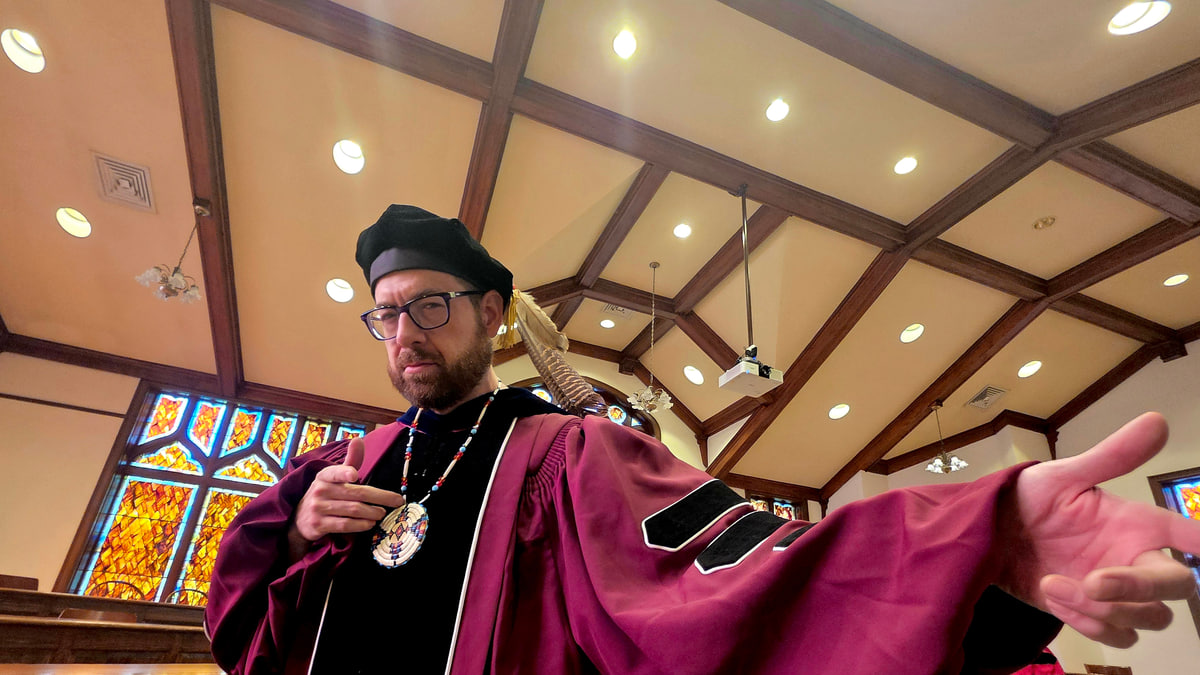
Darren Lone Fight
Research informs what we build.
His work connects Indigenous art and philosophy, archives and interfaces, public humanities, and the translation of research into working systems.
Explore Darren’s public workStart a conversation
Bring a research question.
We welcome exchanges across scholarship, design, archives, and public-interest systems.